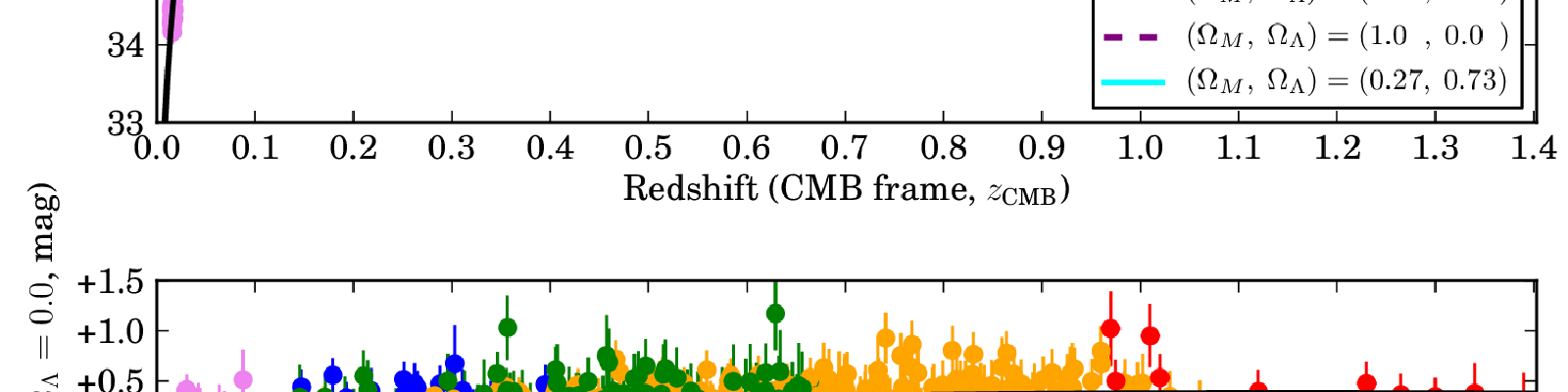
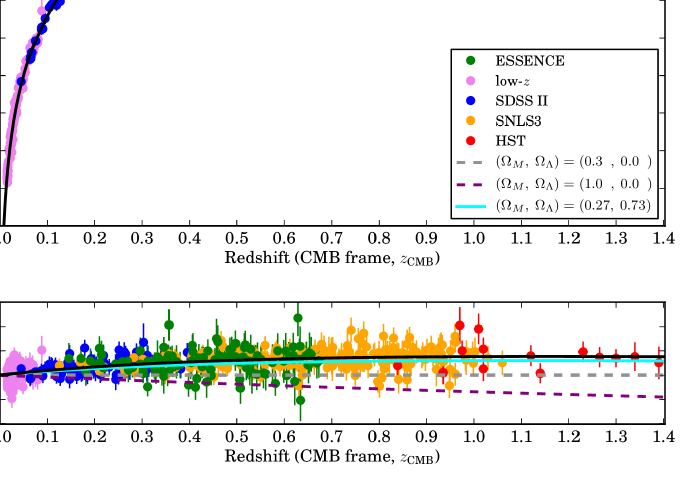
Since the discovery of the accelerating expansion of the Universe in 1998, type Ia supernovae (SN Ia) have remained our most sensitive probe of dark energy. I joined the ESSENCE (Equation of State: SupErNova tracE Cosmic Expansion) project at the start of my graduate studies. ESSENCE observed over 200 SN Ia over seven years, in R and I at a median redshift of 0.4, constraining the equation of state of dark energy, w, to 10%. I was heavily involved in schedule optimization, imaging, spectroscopic follow-up, pipeline development, data reduction and analysis, and led the final analysis for my thesis. I have since been involved in cosmological studies using the Pan-STARRS telescope, and am currently Spokesperson of the LSST Dark Energy Science Collaboration.
A central challenge for the LSST era is achieving fully photometric cosmology—constraining dark energy without spectroscopic confirmation of individual supernovae. My postdoc Ayan Mitra has demonstrated a fully photometric approach to SN Ia cosmology combining joint SN+host photometric redshift fitting with photometric classification, achieving a Figure of Merit of ~150 on simulated LSST-scale samples. This work benefits from two complementary tools developed in my group: ORACLE, a real-time hierarchical deep-learning photometric classifier for LSST led by undergraduate Ved Shah, and SELDON, our foundation AI model for time-domain astrophysics. Photometric redshifts are addressed by methods such as Mantis Shrimp, a multi-survey deep learning photo-z estimator developed by former undergraduate Andrew Engel.
Building accurate SN Ia distance models is equally critical. Together with Prof. Kaisey Mandel (Cambridge), I develop hierarchical Bayesian SN Ia models. We are extending these into the rest-frame z band—which is less sensitive to dust extinction than optical bands—exploiting the synergy between the Young Supernova Experiment (YSE) and LSST DESC. A study by Erin Hayes characterizes SN Ia standardisation properties in the z band using 150 supernovae from YSE and the Foundation Supernova Survey, finding a post-standardization Hubble diagram scatter of 0.195 mag and demonstrating the z band’s potential for Rubin and Roman. We also collaborate with low-redshift surveys that anchor the distance ladder, including DEBASS (Dark Energy Bedrock All-Sky Supernova Survey), which uses DECam on CTIO to build the largest uniformly-calibrated low-z SN Ia dataset in the southern hemisphere, with over 400 spectroscopically confirmed supernovae to date. Accurate cosmology further requires precise photometric calibration: our DA white dwarf spectrophotometric standard network proved critical in the Dovekie reanalysis of the DES 5-year SN Ia sample led by Brodie Popovic, reducing photometric calibration systematic uncertainties by a factor of 1.5 over previous analyses.
We are also extending SN Ia cosmology to strongly lensed supernovae, which offer an independent route to the Hubble constant via time-delay cosmography. Working with Dr. Matt Grayling and Prof. Kaisey Mandel, we developed BayeSN-TD, a Bayesian framework that simultaneously fits SN Ia light curve parameters, gravitational lensing time delays, magnifications, and microlensing effects. BayeSN-TD is now being applied to the lensed supernova SN H0pe by my graduate student Aadya Agrawal, whose analysis of lens models for PLCK G165.7+67.0 reveals systematic magnification biases that must be corrected to achieve precision Hubble constant measurements from lensed transients.