I lead the analysis of a multi-cycle HST program to establish a network of 32 faint (16.5 < V < 19.5) all-sky DA white dwarf spectrophotometric standards alongside three CALSPEC standards. I developed a Bayesian method to coherently model spectroscopy and photometry, inferring SEDs tied to HST’s CALSPEC standards. This work has since been substantially extended by Ben Boyd (Cambridge) working with Prof. Kaisey Mandel and myself into DAmodel, a hierarchical Bayesian framework that jointly infers photometric zeropoints and white dwarf parameters by simultaneously modeling panchromatic HST/WFC3 photometry, HST/STIS UV spectroscopy, and ground-based optical spectroscopy. The calibrated SEDs span 912 Å to 32 μm, achieving <0.004 mag RMS photometric residuals from the UV to the NIR — the lowest yet achieved for a network of this kind. These standards fall within the dynamic range of upcoming wide-field facilities, particularly JWST and the Nancy Grace Roman Space Telescope, where the CALSPEC standards will saturate detectors, and will also calibrate Vera Rubin Observatory’s Legacy Survey of Space and Time. The network has already proven critical: it was used in the Dovekie reanalysis of the DES 5-year Type Ia supernova sample, led by Brodie Popovic, which reduced photometric calibration systematic uncertainties by a factor of 1.5 over previous analyses.
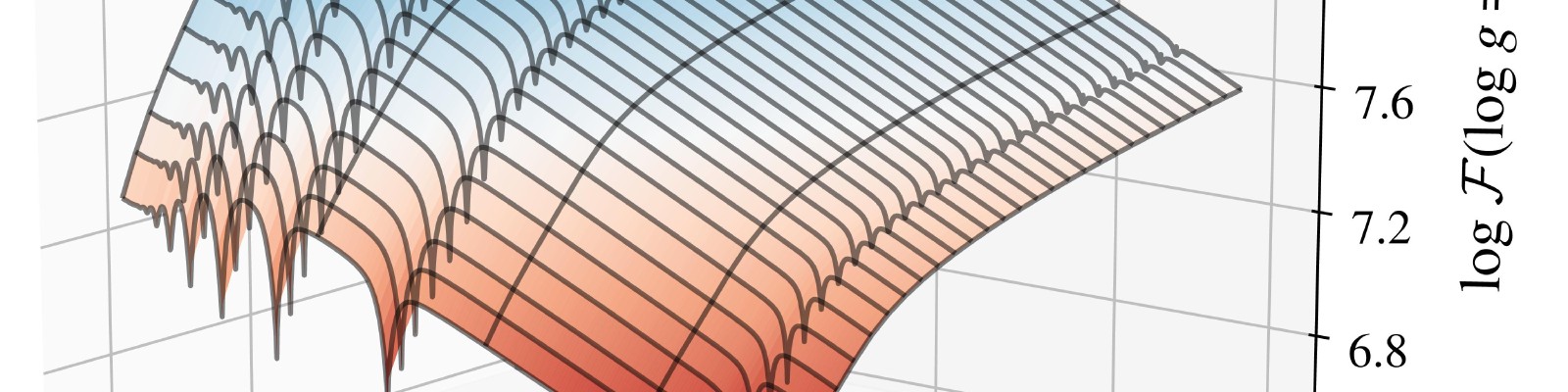 A slice through our grid of DA White Dwarf model atmospheres
Standards for Future Surveys
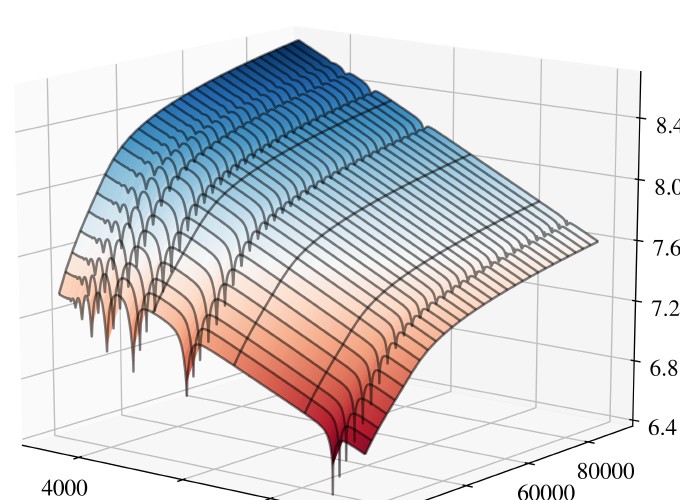 A slice through our grid of DA White Dwarf model atmospheres
Standards for Future Surveys